
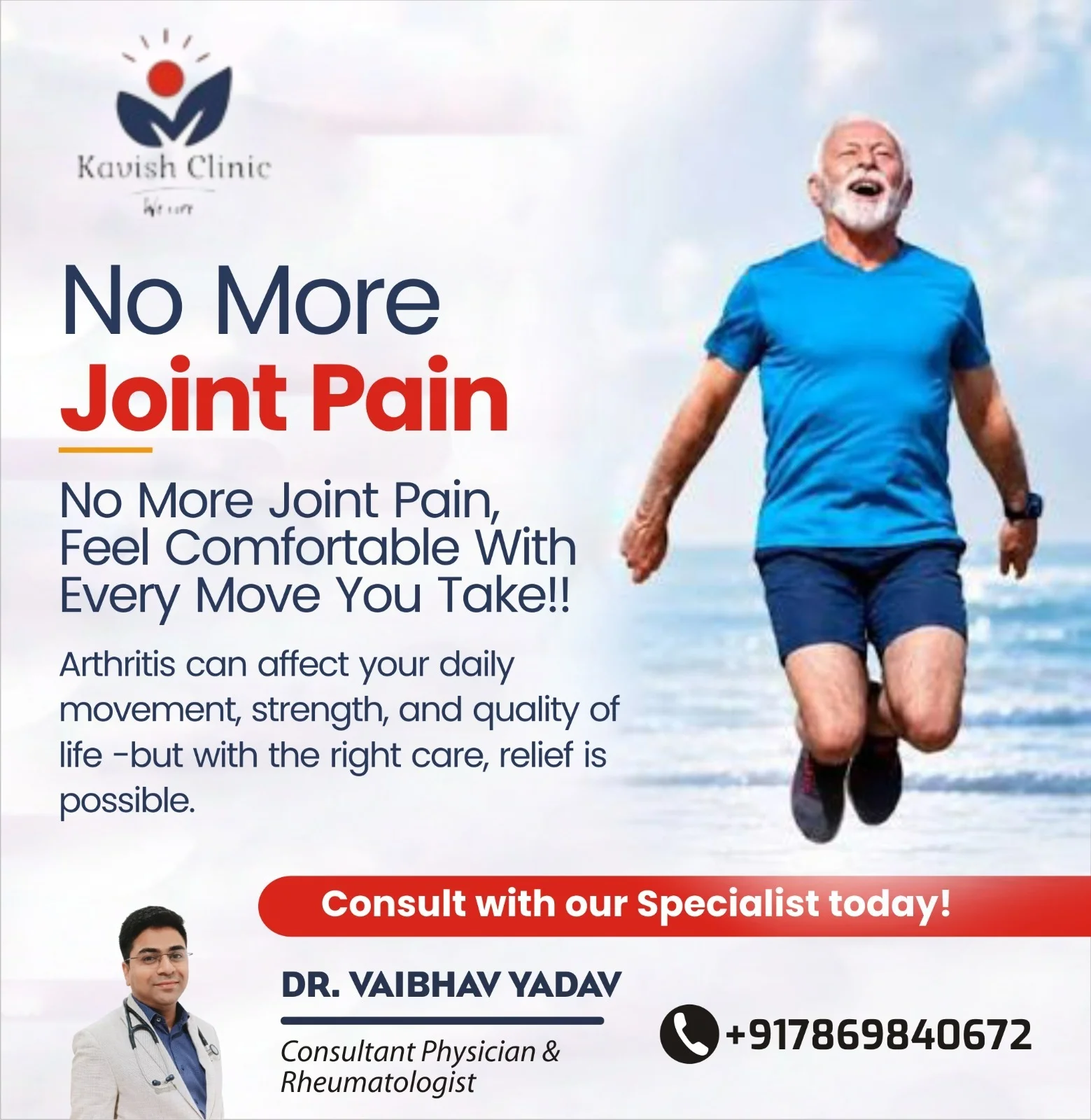
Joint pain can gradually interfere with walking, climbing stairs, working, exercising, sleeping, and performing routine household activities. While occasional discomfort may occur after physical strain, recurring stiffness, swelling, tenderness, or reduced movement may indicate an underlying joint or rheumatological condition that deserves medical attention.
If you are searching for the Best Rheumatologist for Joint Pain in Indore, a specialist consultation can help identify whether your symptoms are related to arthritis, inflammation, autoimmune disease, gout, or another musculoskeletal condition. Dr. Vaibhav Yadav – Kavish Clinic provides evaluation and medical guidance for patients experiencing persistent joint pain and rheumatological concerns in Indore.
Timely assessment is valuable because different forms of arthritis require different treatment approaches. Managing only the pain without identifying its cause may delay appropriate care.
Joint discomfort can arise from several conditions affecting cartilage, bones, muscles, ligaments, tendons, or the immune system.
Common causes may include:
· Osteoarthritis
· Rheumatoid arthritis
· Gout
· Ankylosing spondylitis
· Psoriatic arthritis
· Bursitis
· Tendon-related inflammation
· Previous joint injuries
· Autoimmune disorders
· Age-related joint degeneration
The pattern of symptoms can provide important clues. Pain caused by wear-and-tear arthritis may behave differently from inflammation caused by an autoimmune condition.
A joint pain specialist in Indore can evaluate the nature of your symptoms before recommending investigations or treatment.
People often assume that joint pain is simply part of ageing. However, persistent pain or stiffness should not automatically be accepted as normal.
Consider consulting a rheumatologist in Indore if you experience:
· Joint pain lasting for several weeks
· Morning stiffness that persists after waking
· Swollen or warm joints
· Pain affecting multiple joints
· Recurrent joint redness
· Difficulty using your hands or fingers
· Persistent knee, wrist, ankle, or shoulder pain
· Unexplained fatigue with joint symptoms
· Repeated episodes of severe toe or ankle pain
· Reduced movement without a clear injury
Early evaluation may be particularly important if symptoms are progressively worsening.
Arthritis is a broad term referring to conditions that affect one or more joints.
There are many forms of arthritis, and their causes can differ significantly.
Some types are primarily related to cartilage degeneration, while others involve immune-system-driven inflammation.
For this reason, arthritis treatment in Indore should be based on the specific diagnosis rather than on symptoms alone.
Osteoarthritis is one of the most common forms of arthritis.
It develops when cartilage and other joint structures change over time. It commonly affects weight-bearing joints such as the knees and hips, although the hands and spine may also be involved.
Typical symptoms can include:
· Pain during activity
· Stiffness after rest
· Reduced joint movement
· Difficulty climbing stairs
· Clicking or grinding sensations
· Discomfort after prolonged standing
Treatment may involve lifestyle guidance, exercise, weight management, medicines, and other interventions depending on severity.
People seeking osteoarthritis treatment in Indore should undergo proper evaluation to determine the extent of joint involvement.
Rheumatoid arthritis is an autoimmune inflammatory condition in which the immune system attacks the lining of the joints.
It may affect multiple joints and can produce prolonged stiffness, swelling, pain, and fatigue.
Commonly affected areas include:
· Fingers
· Wrists
· Knees
· Ankles
· Feet
Symptoms may appear on both sides of the body.
Early rheumatoid arthritis treatment in Indore is important because uncontrolled inflammation may contribute to long-term joint damage.
Treatment is usually aimed at controlling inflammation, relieving symptoms, preserving joint function, and reducing progression.
Gout is an inflammatory form of arthritis associated with uric acid crystal deposition in the joints.
It often causes sudden and intense pain, especially in the big toe, although other joints can also be affected.
A gout attack may cause:
· Severe pain
· Redness
· Swelling
· Warmth
· Extreme tenderness
Patients with repeated episodes should seek gout treatment in Indore rather than relying only on pain-relief medicines during attacks.
Medical management may include evaluation of uric acid levels, risk factors, lifestyle, and appropriate medication.
Not all rheumatological diseases mainly affect the knees or hands.
Ankylosing spondylitis is an inflammatory condition that commonly affects the spine and sacroiliac joints.
Possible symptoms include:
· Persistent lower-back pain
· Morning stiffness
· Pain improving with movement
· Reduced spinal flexibility
· Hip or buttock discomfort
Young or middle-aged adults with long-standing inflammatory-type back pain may benefit from evaluation by a rheumatology specialist in Indore.
A detailed diagnosis typically begins with medical history and physical examination.
The doctor may ask about:
· Duration of symptoms
· Number of joints affected
· Morning stiffness
· Swelling pattern
· Family history
· Previous injuries
· Fever or fatigue
· Skin changes
· Medication history
Depending on the findings, further tests may be advised.
These can include:
· Blood tests
· Uric acid testing
· Inflammatory markers
· Autoimmune-related blood investigations
· X-rays
· Ultrasound
· MRI in selected cases
The aim is to identify the underlying disease rather than simply label every symptom as arthritis.
Some inflammatory joint disorders may progress silently even when symptoms appear manageable.
Early diagnosis can help:
· Control inflammation
· Reduce pain and stiffness
· Preserve movement
· Protect joint function
· Prevent avoidable damage
· Improve quality of life
· Support long-term disease management
This is particularly important in autoimmune forms of arthritis.
A consultation with a rheumatoid arthritis specialist in Indore may therefore be useful when joint swelling and morning stiffness persist.
The treatment plan depends on the diagnosis.
Different medicines may be used depending on whether the problem is degenerative, inflammatory, autoimmune, or related to uric acid.
Patients should avoid long-term self-medication with painkillers because these medicines may have side effects and may not address the underlying disease.
Appropriate exercise can help maintain mobility and muscle strength.
The type and intensity of activity should match the patient's condition.
Excess body weight may increase load on weight-bearing joints, especially the knees and hips.
Weight management may form part of a comprehensive joint-care plan.
Physiotherapy may help improve strength, mobility, posture, and functional ability in selected conditions.
Inflammatory and autoimmune rheumatological diseases may require specialized medications designed to control the disease process rather than simply relieve pain.
Joint pain becomes more common with age, but severe limitation should not automatically be considered inevitable.
Older adults may experience problems because of:
· Osteoarthritis
· Muscle weakness
· Reduced flexibility
· Previous injuries
· Inflammatory conditions
· Osteoporosis-related issues
Evaluation by a joint pain doctor in Indore can help identify which factors are contributing to reduced movement.
The goal is to support mobility, independence, and everyday comfort.
Lifestyle changes can support medical treatment but should not replace professional care when arthritis is significant.
Useful habits may include:
· Maintaining a healthy body weight
· Performing regular low-impact exercise
· Avoiding prolonged inactivity
· Following prescribed medicines
· Getting adequate sleep
· Avoiding smoking
· Eating a balanced diet
· Protecting joints during repetitive tasks
Some conditions may require specific dietary advice, especially gout.
False. Some autoimmune forms of arthritis can occur in younger adults and even children.
Joint pain can have many causes. Calcium deficiency is not responsible for every joint problem.
Appropriate exercise can often support joint function. However, exercises should be chosen according to the condition.
Painkillers may reduce symptoms temporarily but do not necessarily treat the underlying cause of arthritis.
If joint pain is persistent, affects several joints, causes swelling, or is associated with prolonged morning stiffness, a rheumatologist may be appropriate. The specialist can evaluate whether an inflammatory or autoimmune condition is involved.
Rheumatoid arthritis can often be managed with appropriate medical treatment. Early diagnosis and consistent follow-up are important for controlling inflammation and reducing the risk of joint damage.
No. Knee pain may result from arthritis, injury, tendon problems, muscle weakness, or other conditions. Clinical assessment helps identify the actual cause.
Sudden painful swelling, redness, warmth, fever, or inability to use the joint should be medically assessed promptly, as these symptoms may require timely diagnosis.
Persistent joint pain, swelling, stiffness, or difficulty moving should not be ignored or managed indefinitely with temporary remedies. Identifying whether the problem is osteoarthritis, rheumatoid arthritis, gout, or another rheumatological condition is the foundation of effective treatment.
For professional joint pain and arthritis treatment in Indore, consult Dr. Vaibhav Yadav – Kavish Clinic for specialized rheumatology evaluation and an individualized management plan.
Contact Us Today to schedule a consultation and take a proactive step toward better mobility and healthier joints.
| Tags: | #Best Rheumatologist for Joint Pain in Indore |


