
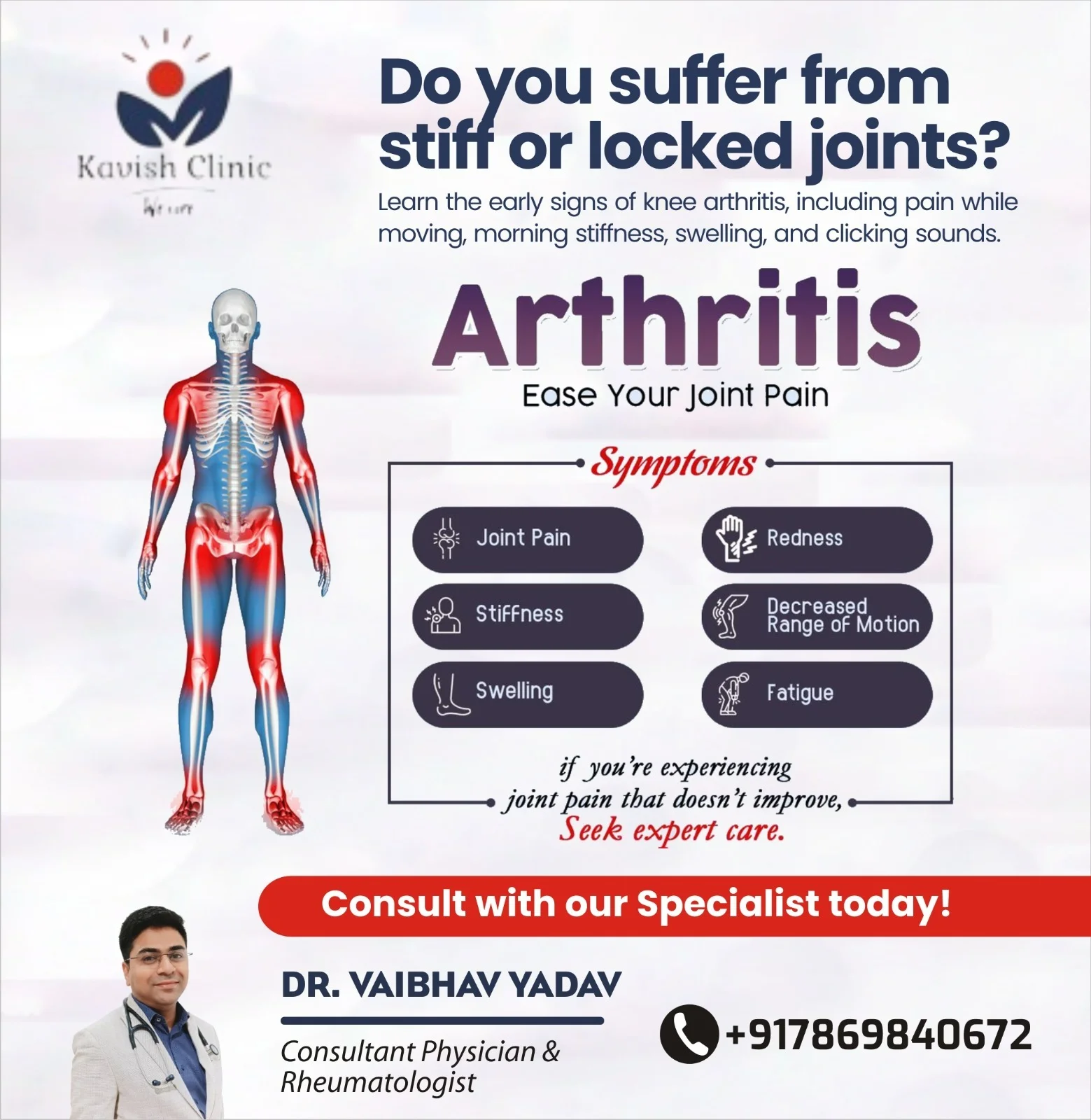
Joint pain that continues for weeks, morning stiffness that makes it difficult to start the day, or swelling that repeatedly returns should not be dismissed as a normal part of ageing. These symptoms may be associated with arthritis, a broad group of conditions that can affect joints and surrounding tissues. Identifying the type of arthritis early is important because treatment differs considerably depending on the underlying cause.
For people searching for professional Arthritis Treatment in Indore, Kavish Clinic provides specialist consultation with Dr. Vaibhav Yadav for the evaluation and management of joint pain, stiffness, swelling, reduced movement, and other rheumatological concerns. A personalized approach can help control symptoms, protect joint function, and support greater independence in everyday activities.
Arthritis is a term used for conditions that affect one or more joints. Although pain is a common feature, some types of arthritis can also produce inflammation, swelling, warmth, stiffness, and gradual changes in joint function.
Arthritis may affect:
There are many different forms of arthritis. For this reason, persistent joint pain should be properly evaluated rather than treated only with repeated painkillers.
People looking for Arthritis Treatment in Indore may have very different underlying conditions. Some have age-related osteoarthritis, while others may be experiencing an inflammatory or autoimmune disorder such as rheumatoid arthritis.
Effective management therefore begins with identifying the cause.
A rheumatology assessment may consider:
This information helps determine which investigations and treatments may be appropriate.
Arthritis symptoms vary depending on the condition and severity.
Common warning signs include:
If these symptoms persist, a consultation with an arthritis specialist in Indore can help establish whether arthritis or another musculoskeletal condition is responsible.
Morning stiffness can provide useful information during arthritis evaluation.
People with osteoarthritis may experience stiffness after rest that gradually improves with movement. In inflammatory forms of arthritis, morning stiffness can sometimes last longer and may involve several joints.
The duration and pattern of stiffness should therefore be mentioned during your medical consultation.
Stiffness alone does not confirm a particular diagnosis, but combined with swelling, pain patterns, and examination findings, it can help guide further testing.
Osteoarthritis develops when changes occur in the cartilage and other structures within a joint. It commonly affects weight-bearing joints such as the knees and hips but can also involve the hands and spine.
Common symptoms include:
For patients requiring osteoarthritis treatment in Indore, management may involve exercise, weight management, pain-control strategies, physiotherapy, lifestyle modification, and other treatments depending on severity.
The knee is one of the joints most commonly affected by arthritis because it carries considerable body weight during standing and movement.
Signs of knee arthritis may include:
Seeking knee arthritis treatment in Indore at an earlier stage can help patients understand which measures may preserve mobility and reduce unnecessary strain on the joint.
Rheumatoid arthritis is an autoimmune inflammatory disease in which the immune system mistakenly attacks joint tissues.
It can cause:
Unlike routine wear-and-tear arthritis, rheumatoid arthritis may require disease-modifying medicines that control the underlying inflammatory process.
Timely rheumatoid arthritis treatment in Indore is important because early disease control may help reduce the risk of long-term joint damage.
Swelling can develop when inflammation increases fluid or tissue changes around a joint.
An inflamed joint may feel:
However, swelling can also occur due to injuries, gout, infection, or other conditions.
Repeated joint swelling therefore warrants professional assessment rather than assuming it is always due to arthritis.
Redness or warmth may indicate active inflammation.
Sudden severe redness, swelling, and pain in one joint should be assessed promptly because causes can include gout, infection, or acute inflammatory arthritis.
A rheumatologist in Indore can evaluate the pattern of symptoms and recommend blood tests, imaging, or joint-fluid testing when necessary.
There is no single test that diagnoses every form of arthritis.
A comprehensive evaluation usually begins with medical history and physical examination.
Depending on symptoms, investigations may include:
Blood tests can help identify inflammatory markers or antibodies associated with certain rheumatological disorders.
X-rays may reveal changes in joint space, bone structure, or osteoarthritis severity.
Musculoskeletal ultrasound can sometimes help detect inflammation or fluid around joints.
MRI may be recommended in selected situations to assess soft tissues, cartilage, or other structures in greater detail.
When a joint is significantly swollen, fluid analysis may sometimes help identify gout, infection, or other causes.
Tests are selected according to clinical need rather than being identical for every patient.
Treatment should be individualized according to arthritis type, age, symptom severity, medical history, and affected joints.
Depending on the diagnosis, doctors may recommend medicines for:
Medication should be taken only as advised because prolonged unsupervised use of certain painkillers can have unwanted effects.
Appropriate exercise can improve joint mobility and strengthen the muscles that support affected joints.
A physiotherapy program may include:
Exercises should be selected according to the affected joint and individual ability.
For people who are overweight, gradual weight reduction can reduce mechanical stress on weight-bearing joints such as the knees.
Small changes in daily activities may reduce joint strain while allowing people to remain active.
Yes, in many cases appropriate exercise is an important part of arthritis management.
Complete inactivity can lead to:
Low-impact activities may include walking, cycling, swimming, stretching, or exercises prescribed by a physiotherapist.
During significant inflammatory flare-ups, activity may need to be modified temporarily. Your doctor or physiotherapist can help determine what is safe.
Consider seeking rheumatology consultation in Indore if you experience:
Early evaluation is particularly important when symptoms are worsening or beginning to interfere with work, sleep, walking, or self-care.
Whether arthritis can be cured depends on its type.
Many chronic forms cannot simply be “cured,” but symptoms and disease activity can often be managed effectively. In inflammatory arthritis, modern treatments can sometimes achieve substantial disease control or remission.
The goals of treatment generally include:
Regular follow-up helps treatment evolve as symptoms change.
Simple habits can support joint health alongside medical treatment:
People with established arthritis should seek advice before starting intense exercise programs.
A rheumatologist specializes in inflammatory and autoimmune joint diseases and can evaluate persistent joint pain, swelling, stiffness, rheumatoid arthritis, gout, and related conditions.
No. Joint discomfort may also occur because of injury, tendon problems, muscle strain, infection, gout, or other conditions. Clinical assessment helps determine the exact cause.
Many patients, particularly in earlier stages, can be managed with appropriate exercise, weight control, physiotherapy, medicines, and lifestyle measures. Surgery is considered according to severity and functional limitation.
Inflammatory processes and prolonged inactivity during sleep can contribute to morning stiffness. The pattern and duration vary between different types of arthritis.
Persistent joint pain should not be accepted as something you simply have to live with. Identifying whether symptoms are caused by osteoarthritis, rheumatoid arthritis, gout, or another rheumatological condition allows treatment to target the underlying problem rather than only providing temporary relief.
For individualized Arthritis Treatment in Indore, Kavish Clinic offers consultation with Dr. Vaibhav Yadav for joint pain, stiffness, swelling, rheumatoid arthritis, and other rheumatological concerns.
If joint pain, morning stiffness, or swelling is affecting your mobility or everyday routine, timely specialist evaluation can help you understand the cause and available treatment options.
Book your arthritis consultation in Indore today and take an informed step toward better joint mobility, comfort, and long-term health.
| Tags: | #Arthritis Treatment in Indore |


