
Pain in the lower back, buttocks, hips, or pelvic region can sometimes be related to the sacroiliac (SI) joints. The SI joints connect the lower spine to the pelvis and help transfer forces between the upper body and legs.
SI joint discomfort may be mild initially, but persistent pain can interfere with walking, sitting, climbing stairs, exercising, sleeping, and everyday movement.
Sacroiliitis is inflammation of one or both sacroiliac joints. Pain and stiffness around the lower back or buttocks are common symptoms and may sometimes radiate toward the legs.
For proper SI Joint Pain Treatment in Indore, it is important to understand the possible cause of the pain rather than trying random exercises.
SI joint pain can be related to mechanical stress, inflammatory arthritis, pregnancy-related changes, previous injury, or other musculoskeletal conditions.
Kavish Clinic in Indore offers consultation with Dr. Vaibhav Yadav, Consultant Physician & Rheumatologist, for joint pain and rheumatology-related concerns.
The sacroiliac joints are located where the sacrum, the triangular bone at the bottom of the spine, meets the pelvis. There is one SI joint on each side.
These joints help transfer forces between the upper body and legs and contribute to pelvic stability.
When an SI joint becomes irritated or inflamed, pain may be felt in the:
SI joint symptoms can resemble other causes of lower back and hip pain, so clinical assessment may be needed before deciding on treatment.
If you are looking for an SI Joint Pain Specialist in Indore, symptoms that may require evaluation include:
Sacroiliac pain may become worse with prolonged sitting or standing and activities such as climbing stairs.
However, many conditions can cause lower back and buttock pain, so symptoms alone cannot confirm that the SI joint is the source of the problem.
SI joint pain can have several possible causes.
Changes in movement, repetitive loading, prolonged activity, or altered movement patterns can place additional stress on the pelvic region.
Structures around the SI joint may be affected by falls, sports injuries, road accidents, or direct trauma.
Pregnancy can cause changes in posture, pelvic loading, and the supporting structures around the pelvis. These changes may contribute to SI region discomfort in some people.
Inflammatory rheumatic diseases, particularly axial spondyloarthritis and related conditions, can cause inflammation around the SI joints.
Inflammatory back pain may be associated with morning stiffness and symptoms that improve with activity rather than rest.
Changes in walking patterns, gait, or other biomechanical factors may affect how forces are transferred through the pelvis.
Not all SI joint pain is mechanical.
If pain persists and is associated with significant morning stiffness or other inflammatory symptoms, evaluation by a Rheumatologist in Indore may be appropriate.
Features that may suggest inflammatory back pain include:
Having these symptoms does not automatically mean that a person has inflammatory arthritis. Clinical assessment and appropriate investigations are required.
Exercise can be an important part of managing SI-region pain for many people, but the exercises should ideally be selected according to the underlying cause.
Physical therapy for sacroiliac pain may include range-of-motion exercises, stretching, strengthening, and stability exercises to support movement and function.
Low-impact activities such as walking, cycling, and swimming may also be suitable for some people.
Prolonged complete rest is generally not recommended for many musculoskeletal conditions.
The important point is that not every exercise available online is appropriate for every type of SI joint problem.
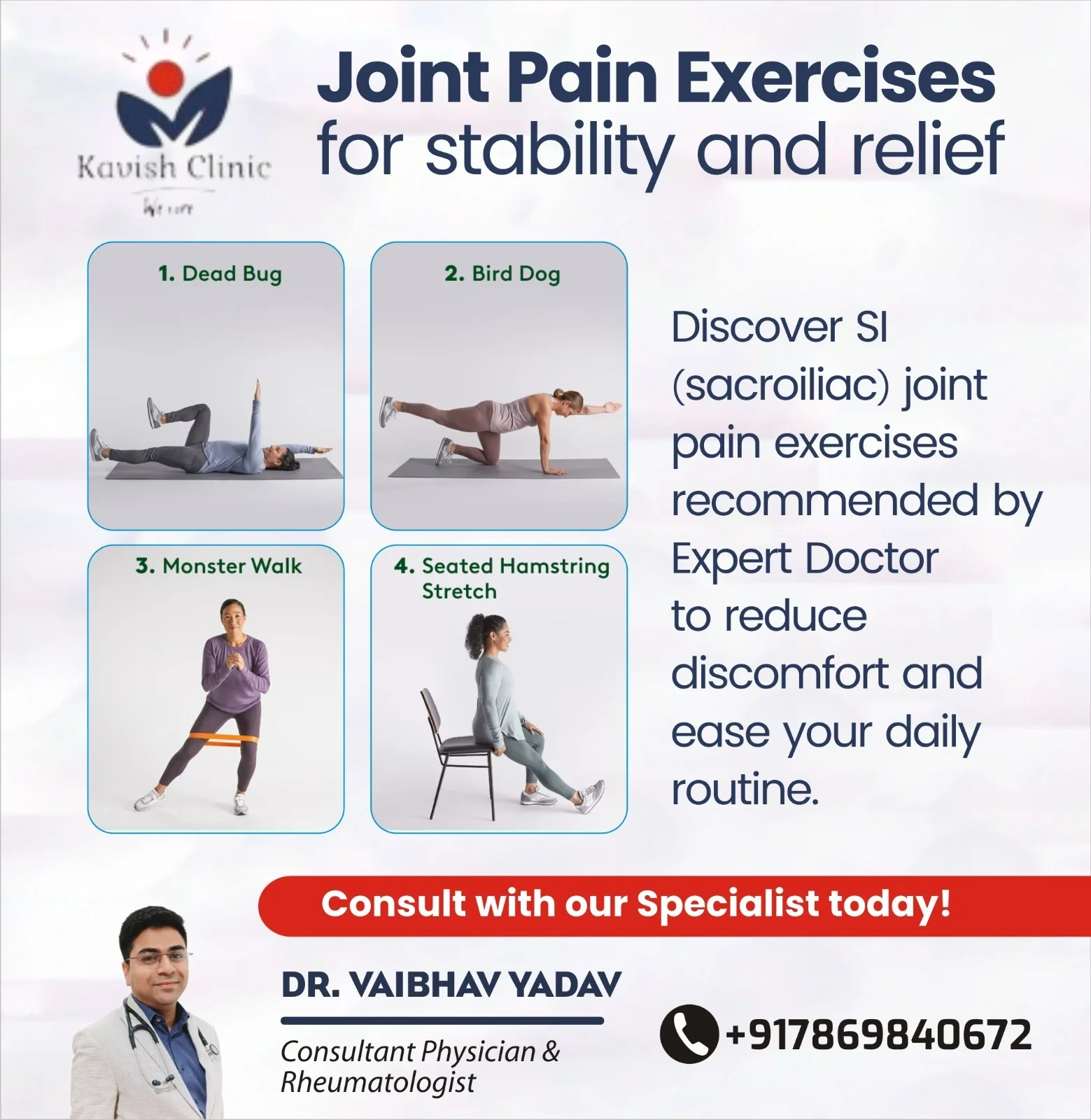
Exercises such as Dead Bug, Bird Dog, Monster Walk, and Seated Hamstring Stretch are commonly included in mobility, strengthening, or stability programs.
Their suitability depends on the diagnosis, pain level, movement control, and individual health condition.
The Dead Bug is commonly used to improve trunk control.
It is performed while lying on the back and moving opposite arms and legs in a controlled manner.
It may help develop:
The exercise should be performed with controlled movements. If it increases lower back or pelvic pain, stop and discuss the exercise with a professional.
Bird Dog begins on the hands and knees and involves slowly extending the opposite arm and leg.
It can be used to improve:
The focus should be on controlled movement rather than lifting the arm or leg as high as possible.
People with severe pain, balance difficulties, or wrist and knee problems may require modifications.
Monster Walks generally involve a resistance band placed around the thighs or legs.
The exercise targets muscles around the hips that contribute to pelvic and lower-limb stability.
A personalized strengthening program may include exercises for the hips and trunk to improve support and movement control.
The correct technique and suitable resistance are more important than using a very strong resistance band.
The seated hamstring stretch gently targets the muscles at the back of the thigh.
Stretching can help maintain flexibility, but it should generally be performed without forcing the body into pain.
If stretching causes nerve-like pain, numbness, or sharp discomfort, professional assessment is recommended.
A person with inflammatory sacroiliitis may require a different management plan from someone with mechanical SI-region pain following an activity or injury.
An exercise program may depend on:
People searching for Joint Pain Exercises in Indore should therefore avoid assuming that one standard online routine will work for every type of SI joint pain.
If tolerated, low-impact physical activity may help maintain mobility and general fitness.
Possible options include:
For people with arthritis-related conditions, low-impact exercise may be more comfortable when intense activity worsens pain or inflammation.
Exercise intensity should generally be increased gradually rather than suddenly.
During an acute flare, temporarily reducing activities that clearly worsen symptoms may be appropriate.
However, prolonged complete rest is generally not recommended for many musculoskeletal conditions.
It may be more helpful to modify activities that aggravate the problem while continuing comfortable movement, according to professional advice.
Walking, cycling, and swimming may be suitable low-impact activities for some people.
Diagnosing SI joint pain can be challenging because symptoms may resemble other lower back, hip, or pelvic conditions.
A doctor may consider:
If an inflammatory condition is suspected, additional investigations may be recommended.
Depending on the clinical situation, these may include blood tests or imaging studies.
Consider Rheumatologist Consultation in Indore if joint or back pain:
Inflammatory conditions need to be differentiated from common mechanical pain because their treatment approaches can be different.
Treatment should be based on the underlying diagnosis rather than simply the location of pain.
Management may include the following.
During painful periods, temporarily reducing movements that clearly aggravate symptoms while maintaining appropriate activity may help.
Depending on the individual condition, stretching, mobility, strengthening, stability, and posture-oriented exercises may be included.
Depending on the cause and medical history, a doctor may prescribe medicines for pain or inflammation.
Medicines should not be started or taken repeatedly without appropriate medical advice.
If SI joint inflammation is related to inflammatory arthritis, treating the underlying rheumatic condition is an important part of long-term management.
After appropriate evaluation, clinicians may consider procedures such as SI joint injections for selected patients.
These procedures are not required or appropriate in every case.
Simple habits may support comfortable movement along with a prescribed treatment plan:
Consistency is generally more useful than occasional intense exercise.
Lower back or joint pain accompanied by certain warning signs requires prompt medical evaluation.
These may include:
When warning signs are present, exercise should not be used as a substitute for medical evaluation.
Depending on the cause, mobility, stretching, strengthening, and stability exercises may be helpful. A doctor or physiotherapist can help select suitable exercises based on the individual's condition.
Walking is a low-impact activity that may be suitable when tolerated. The amount and intensity should depend on the individual's symptoms and underlying condition.
Yes. Inflammatory rheumatic conditions such as axial spondyloarthritis can cause inflammation of the sacroiliac joints. Persistent symptoms suggestive of inflammatory back pain should be evaluated by a healthcare professional.
These exercises may be included in some stability and rehabilitation programs, but they are not suitable for everyone. Exercise selection should be based on the diagnosis, pain severity, movement assessment, and individual health needs.
SI joint discomfort should not always be treated with random stretching or strengthening exercises. The underlying cause may be mechanical, inflammatory, injury-related, or associated with another musculoskeletal condition.
Accurate evaluation can help determine the appropriate treatment approach.
If you are looking for SI Joint Pain Treatment in Indore, you can consult Dr. Vaibhav Yadav, Consultant Physician & Rheumatologist at Kavish Clinic for joint pain, inflammatory arthritis, sacroiliac symptoms, and other rheumatology-related concerns.
Contact Kavish Clinic to book a specialist consultation and receive personalized guidance for joint pain, movement, exercise, and long-term management in Indore.
| Tags: | #SI Joint Pain Treatment in Indore |


